The project Bridge is co-funded by the European Union. Views and opinions expressed are however those of the author(s) only and do not necessarily reflect those of the European Union or the Servicio Espanol para la Internacionalizacion de la Educacion (SEPIE). Neither the European Union nor the National Agency SEPIE can be held responsible for them. -- Number: 2025-1-ES01-KA220-HED-000359236 --

A museum. Seven Challenges. Four spaces to learn and transform

Documentary Photography

This is a collection of photographs or images related to the selected social challenge. Each image is accompanied by a brief description or narrative explaining its meaning and connection with the challenge.

A.7. Digital ecosystem, disinformation and the need for media literacy and critical thinking   Show all

The images selected for Social Challenge A7 depict everyday situations in the digital ecosystem: how feeds are personalised, how attention is drawn to outrage, how AI-generated content and biased data shape what people believe, how hate speech affects those it targets and how people can respond… Read more >>

Same street, two feeds

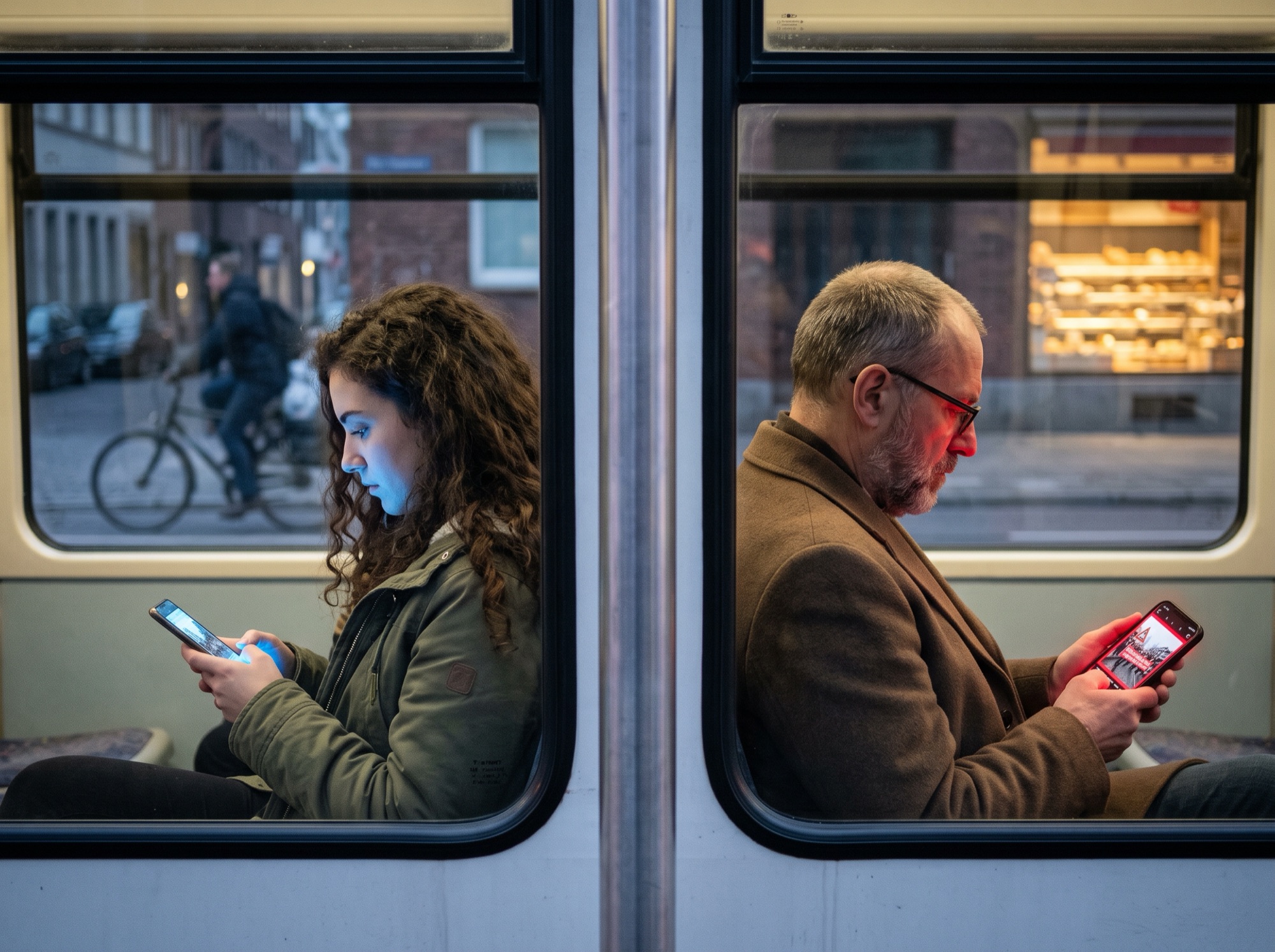
This photograph illustrates how the same event can reach people as two different realities. Seen from the street, a young woman and an older man sit back to back in a tram, separated by a window pillar, each absorbed in their phone. Her screen bathes her face in cold blue light, his in agitated red. Both are looking at the same street demonstration, but on his screen it is framed with red warning signs. Outside, the real street is quiet and ordinary: a cyclist passes, a bakery window glows. The image points to the role of recommendation systems that select and frame content for each user according to past behaviour and engagement. People who share the same physical space can therefore live in very different information environments without noticing it. For Challenge A7, the image introduces a central idea: what we see online is a selection made for us, and understanding this selection is a condition for forming independent opinions and for talking to each other across different feeds.

.. continue >>
Source: Image generated using generative AI for the BRIDGE project.
Too real to be true

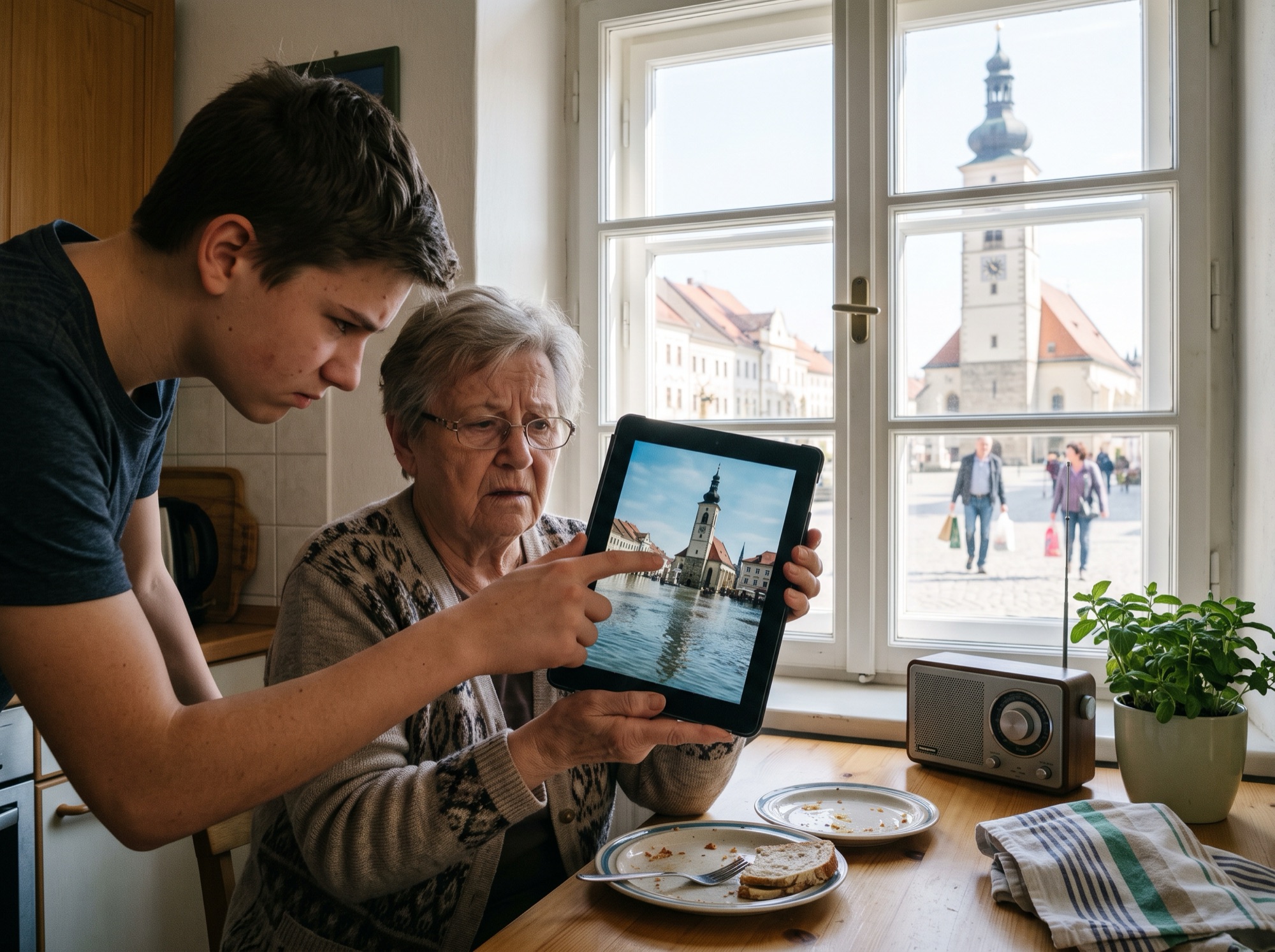
This photograph illustrates how AI-generated images can compete with reality. In a small kitchen, an older woman holds up a tablet showing a dramatic picture of her town square under water. Through the window directly behind the tablet, the real square is visible: the same church tower, dry cobblestones, people walking in the sun. Her grandson leans in and points at the screen with a frown. The image refers to synthetic images that are created or altered with generative AI and spread quickly because they are striking and emotionally charged. Such images can cause fear, mislead people in crisis situations and undermine trust in authentic photographs. The scene also suggests that different generations may approach such content in different ways. For Challenge A7, the image highlights the need to compare what we see on a screen with other sources, including the world around us, before believing or sharing it.

.. continue >>
Source: Image generated using generative AI for the BRIDGE project.
The source that does not exist

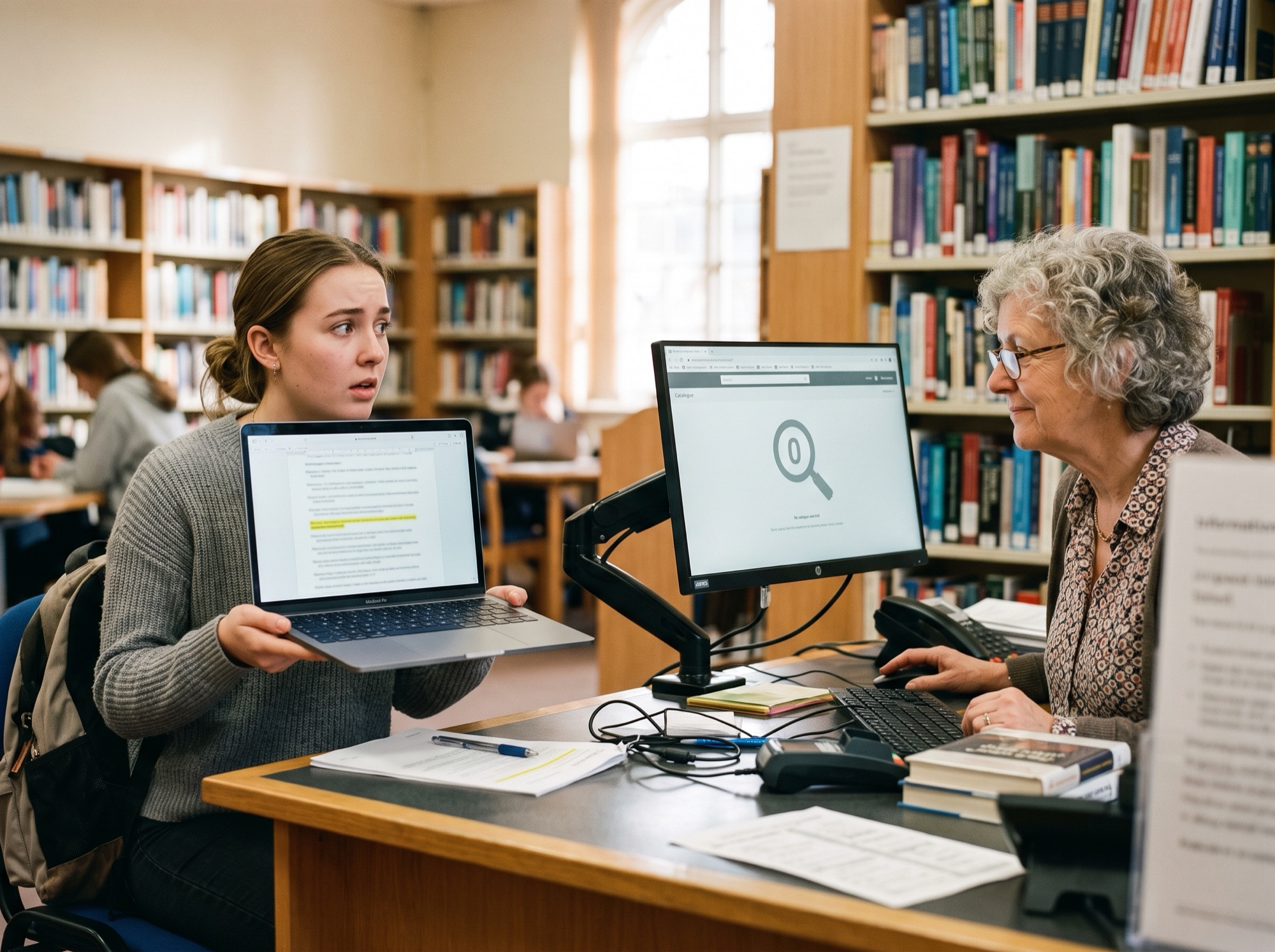
This photograph illustrates the problem of invented sources. At the information desk of a university library, a student holds up her laptop with a neatly formatted reference list and one highlighted entry. Across the desk, a librarian has turned her monitor towards her: the catalogue search shows no results, only a magnifying glass and a zero. The student looks puzzled, the librarian calm and kind. The image refers to the way generative AI tools can produce references, quotations or facts that sound plausible but do not exist, often presented with great confidence. Such errors are not intended to deceive, yet they spread misinformation when they are copied without verification into essays, articles or social media posts. For Challenge A7, the image shows why using AI responsibly requires checking every source against reliable records, and why libraries and information professionals remain important partners in developing critical information literacy in higher education.

.. continue >>
Source: Image generated using generative AI for the BRIDGE project.
Leave the page

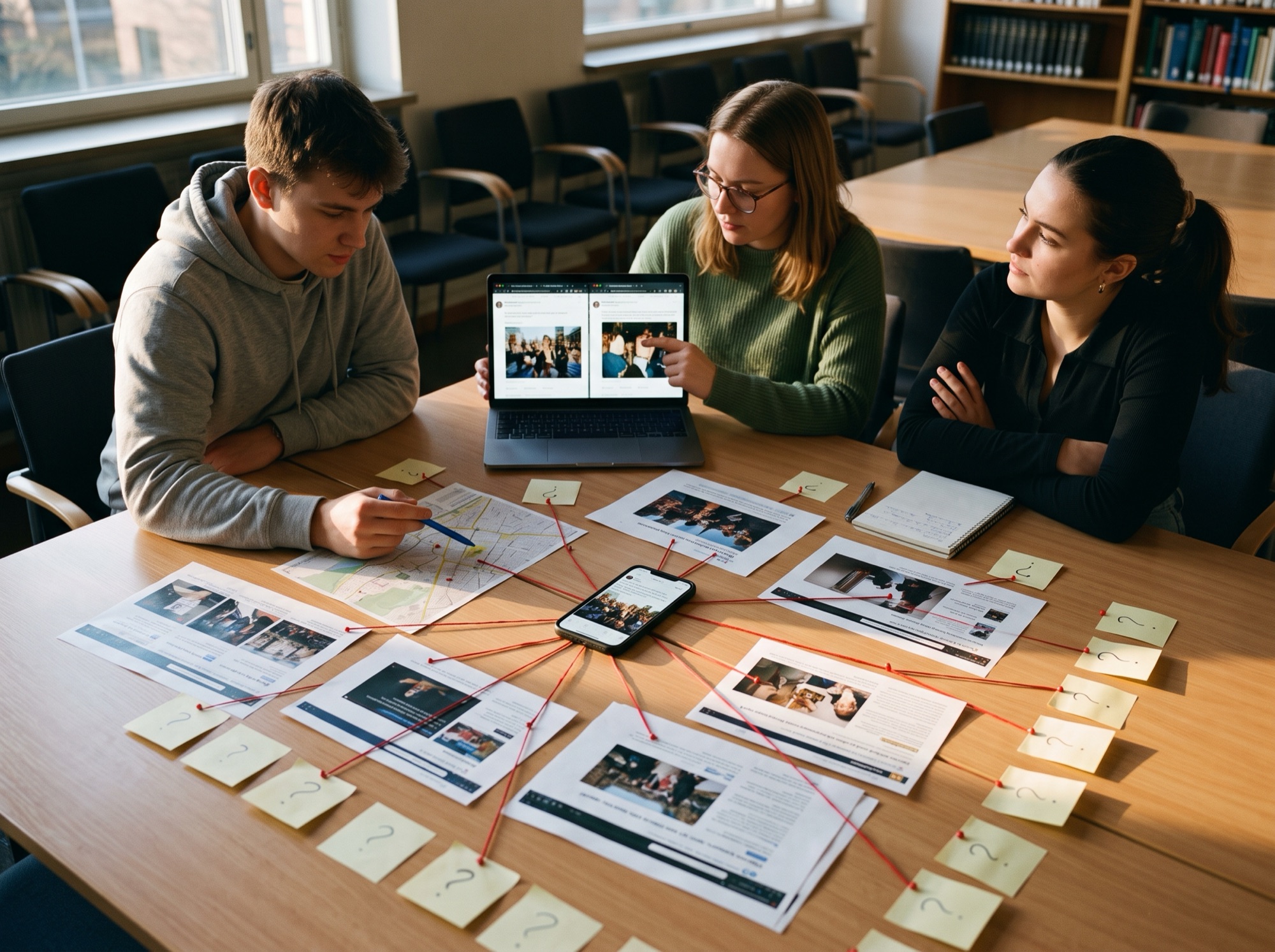
This photograph illustrates a practical method for verifying information online. Three students sit around a seminar table. In the centre lies a phone with a viral post. Around it they have built a small investigation: printed screenshots, a map, a timeline of sticky notes with question marks and a laptop, linked by red thread like a detective's board. One student points at the map, another checks sources on the laptop, the third leans back sceptically. The image refers to lateral reading, a technique in which, instead of examining a single page closely, people leave it and check what other sources say about its author, its claims and the origin of its images. For Challenge A7, the image shows that verification is an active, shared process that takes time and several sources, and that doubt, when it leads to checking rather than to cynicism, is a core element of critical thinking.

.. continue >>
Source: Image generated using generative AI for the BRIDGE project.
Alone with the comments

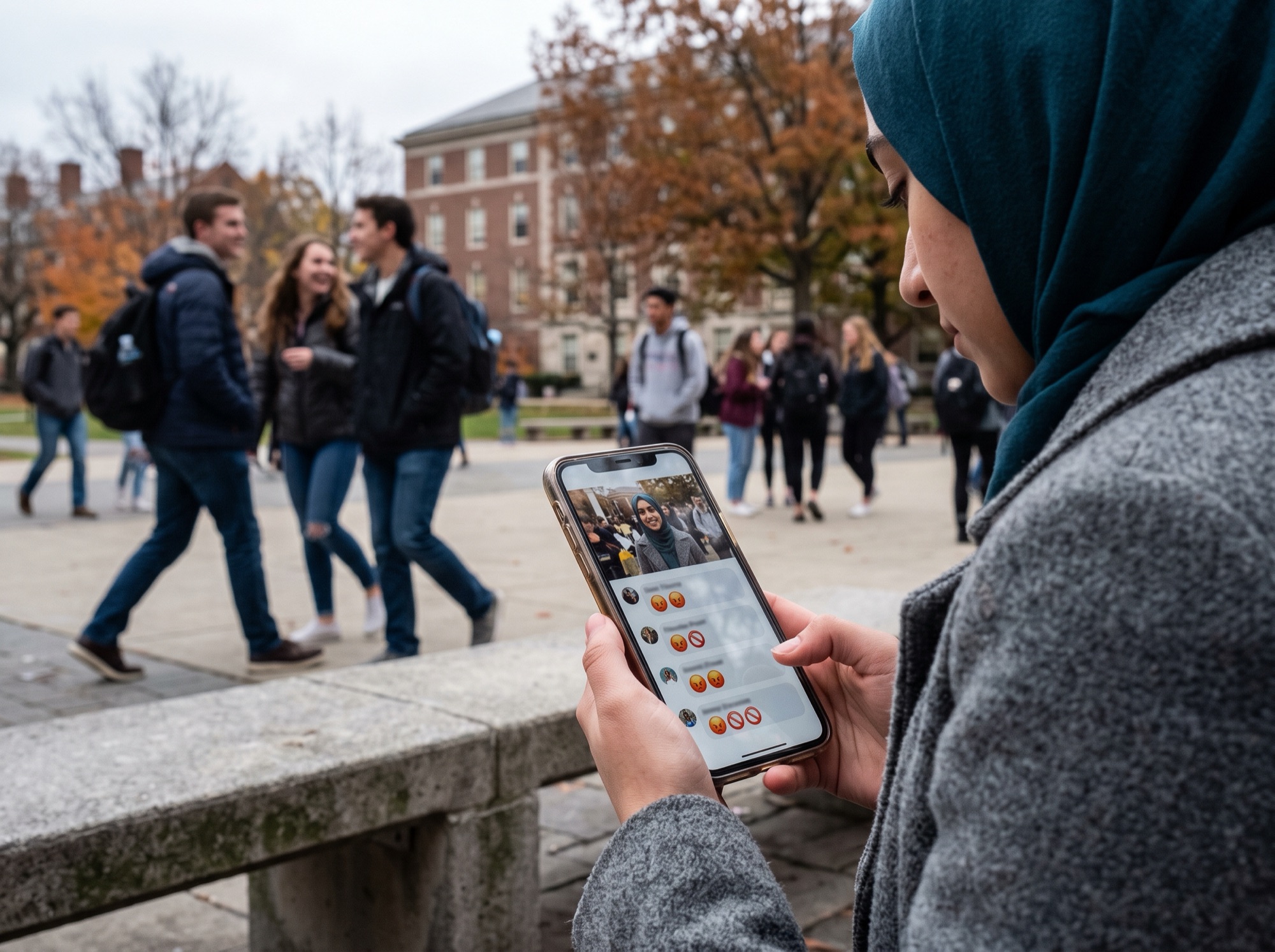
This photograph illustrates how online hate speech can isolate the people it targets. Seen over her shoulder, a young woman wearing a headscarf sits on a bench on a busy campus square and looks at her phone. On the screen, a photo of her smiling at a student event is followed by comments marked with angry faces and crossed-out symbols. Around her, other students walk past, talking and laughing, and nobody notices. The image refers to the way hate speech often targets people because of their religion, origin or other characteristics, and to the gap between the shared public space and the private moment in which the harm is experienced. For Challenge A7, the image invites reflection on the effects of hate speech on individuals and on their participation in academic and public life, and on the responsibility of the university community to notice, support and respond.

.. continue >>
Source: Image generated using generative AI for the BRIDGE project.
Checking together, speaking up together

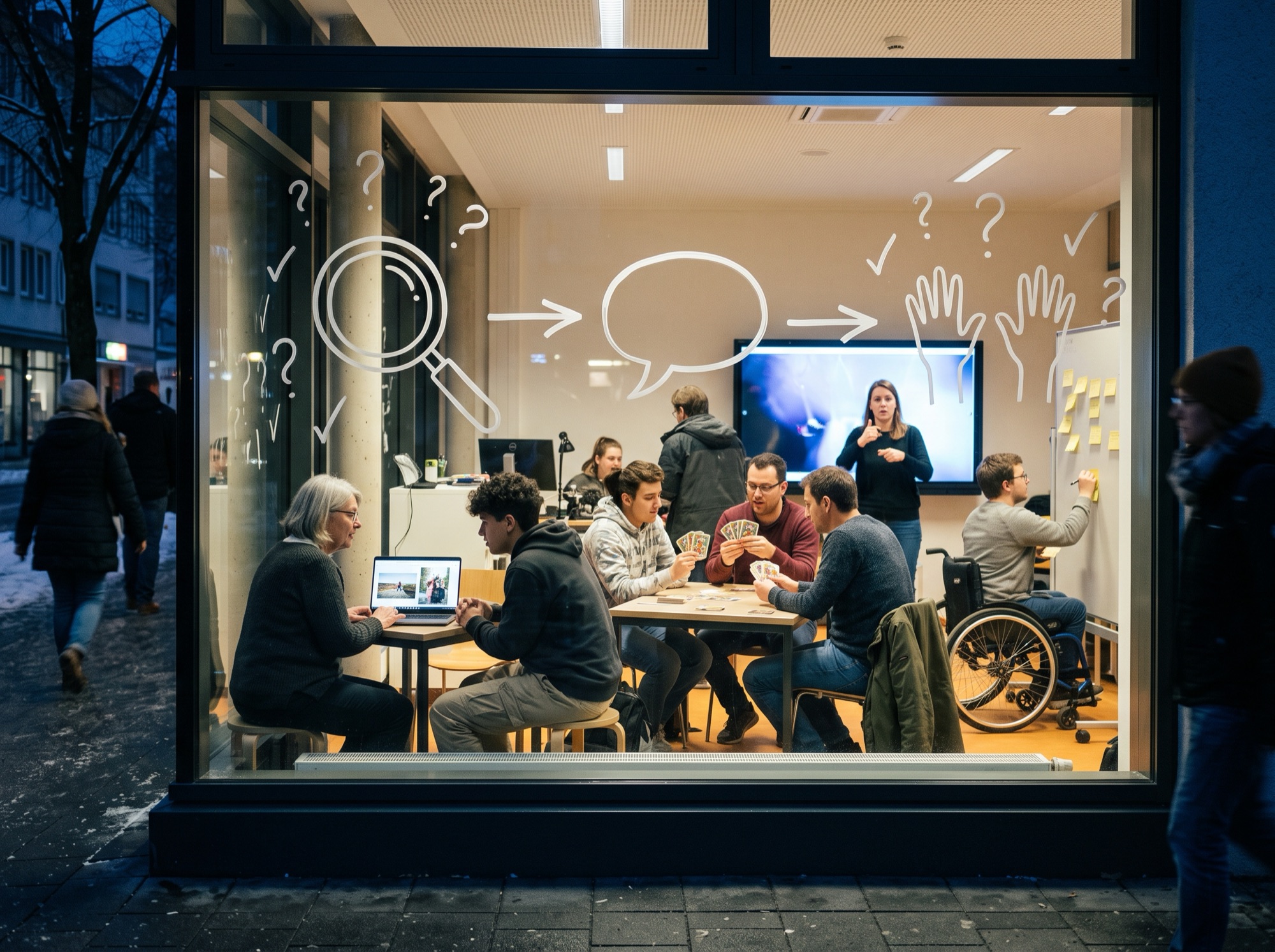
This photograph illustrates what critical digital citizenship can look like in practice. Seen from the snowy street on a winter evening, a large window reveals a university media lab where people of different ages and abilities work together. On the glass, someone has drawn a simple process: a magnifying glass, a speech bubble and raised hands, surrounded by question marks and ticks. Inside, an older woman and a young man compare two photos on a laptop, a group plays an educational card game, a sign language interpreter stands beside a screen and a person in a wheelchair adds notes to a board. Passers-by walk past outside. The image refers to responses to disinformation and hate speech that are collective, open and inclusive: checking information, speaking up and taking part. For Challenge A7, it shows universities as places that can open their doors to the community and build media literacy across generations and abilities.

.. continue >>
Source: Image generated using generative AI for the BRIDGE project.
Where the thumb goes

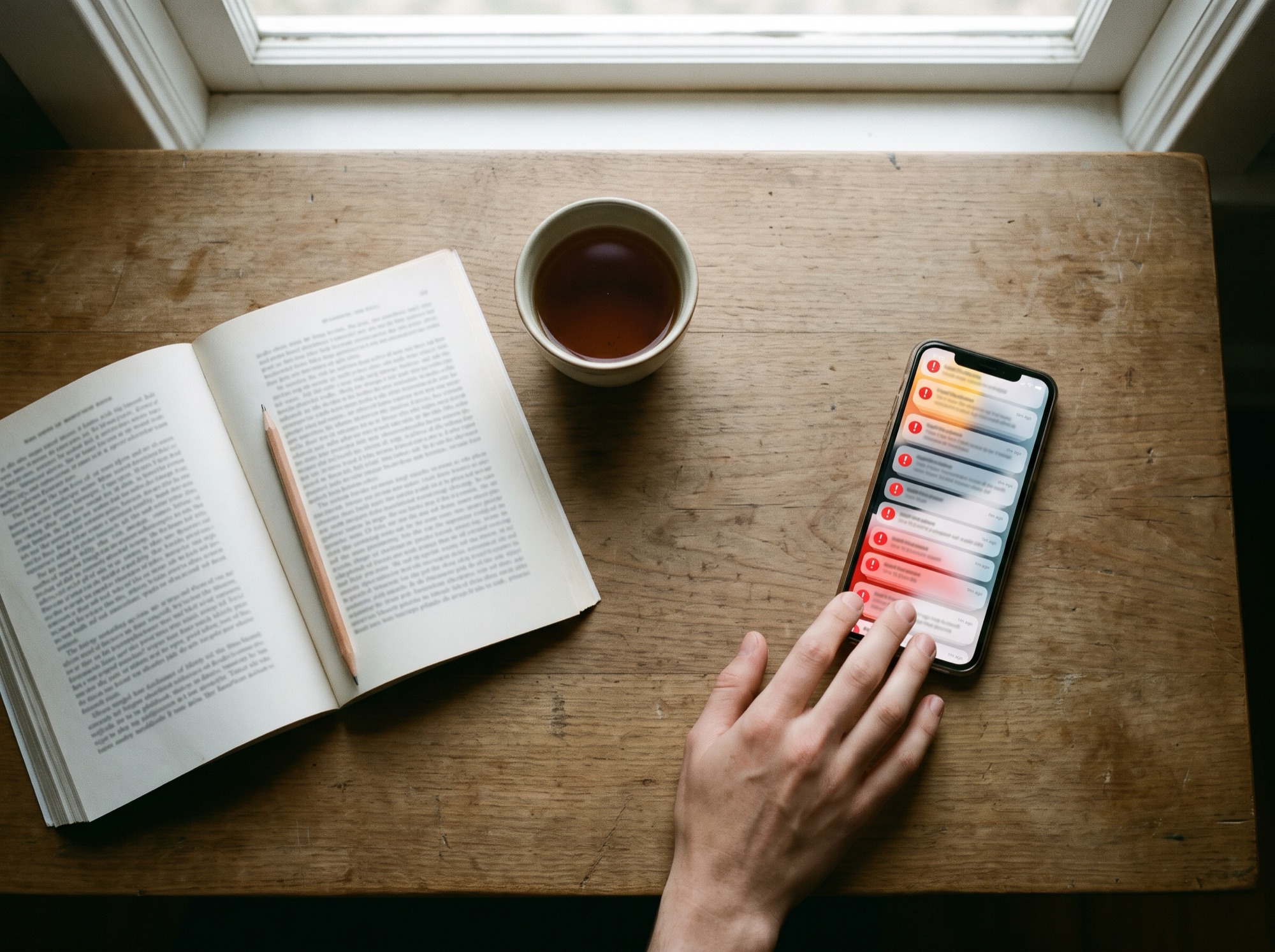
This photograph illustrates how attention is captured in the digital ecosystem. Seen from above, an open book lies on a desk with a pencil resting in the fold, calm and ready to be read. Beside it, a phone lights up with a column of notifications, each marked with a red badge. A hand has just let go of the pencil and is already reaching for the phone. The image refers to the attention economy: platforms and apps are designed to interrupt, to reward quick reactions and to bring people back as often as possible, because attention is what they sell. Content that is urgent, emotional or alarming is favoured over content that takes time. For Challenge A7, the image raises a simple question that every user can ask: who decides where my attention goes, and what do I lose when the loudest signal always wins over the page in front of me?

.. continue >>
Source: Image generated using generative AI for the BRIDGE project.
Look for the label

This photograph illustrates why the labelling of AI-generated content matters. On a tablet, a landscape of flawless beauty fills the screen: a mountain lake at sunrise under perfect pink clouds. In one corner sits a small grey badge with the letters AI. A pencil points at it, and the badge, not the view, is in focus. The image refers to the growing share of synthetic images, videos and texts online and to the labels that platforms and media attach, and that rules such as the European Union's Artificial Intelligence Act increasingly require, so that people can tell generated content from documentary material. Such labels are small and easy to overlook, and they only work if users know to look for them. For Challenge A7, the image connects to the photographs of this collection, which are themselves AI-generated and labelled as such. It invites users to make the label a habit: before admiring, believing or sharing an image, check how it was made.

.. continue >>
Source: Image generated using generative AI for the BRIDGE project.
Before you forward

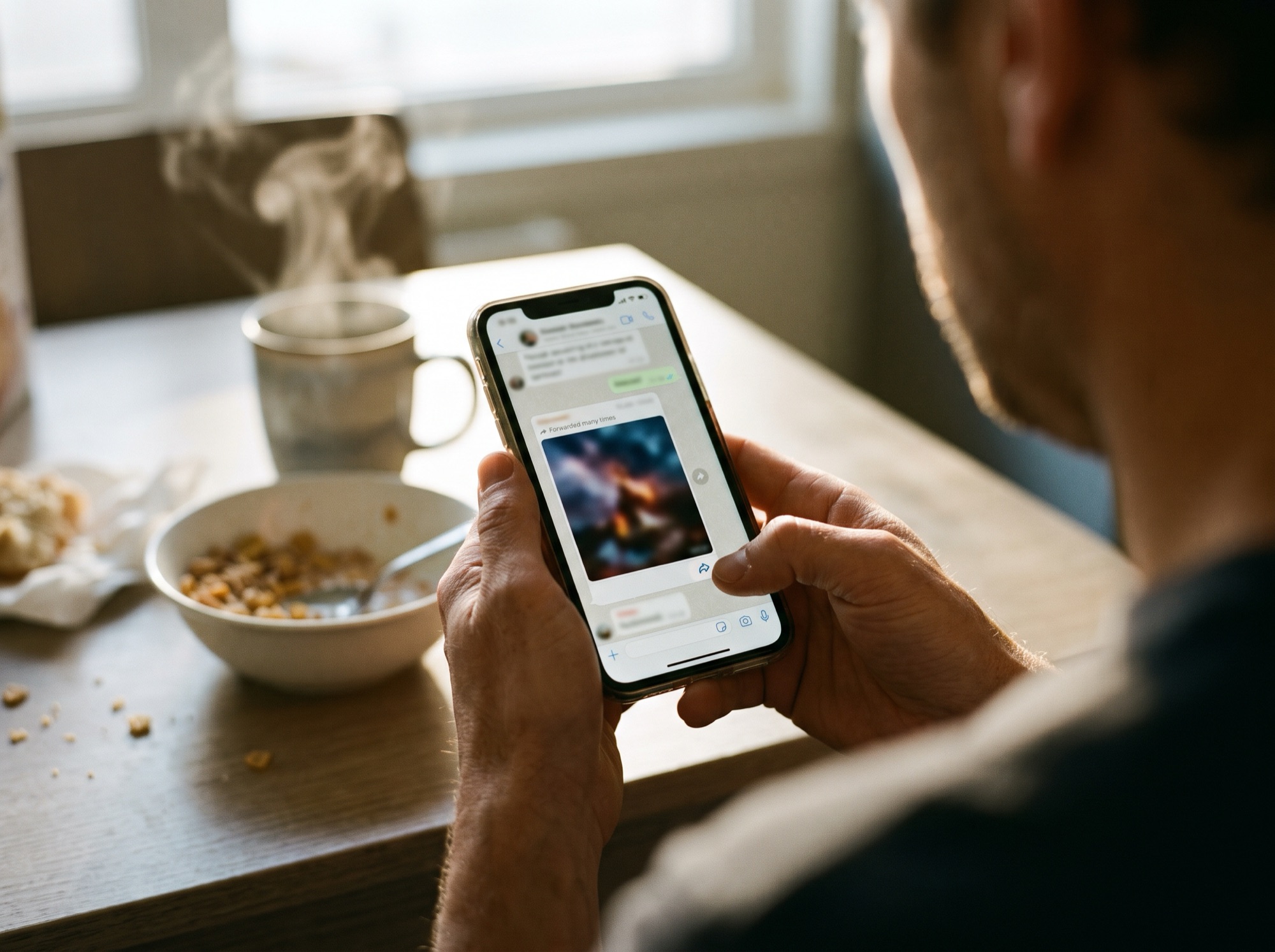
This photograph illustrates the moment before a message is passed on. At a kitchen table, two hands hold a phone with a group chat. The message on the screen has already been forwarded many times, as the small arrow icon shows; its dramatic picture is blurred, its origin unknown. The thumb hovers over the forward button and has not yet touched it. The image refers to the way disinformation travels: not mainly through professional campaigns, but through ordinary people who pass on what alarms, amuses or moves them, often with good intentions and without checking. Every forward lends a message the credibility of a friend. For Challenge A7, the image makes the smallest unit of media literacy visible: a short pause. Who sent this originally, when, and can it be confirmed elsewhere? If the answer is unclear, the most responsible action is often not to forward at all.

.. continue >>
Source: Image generated using generative AI for the BRIDGE project.
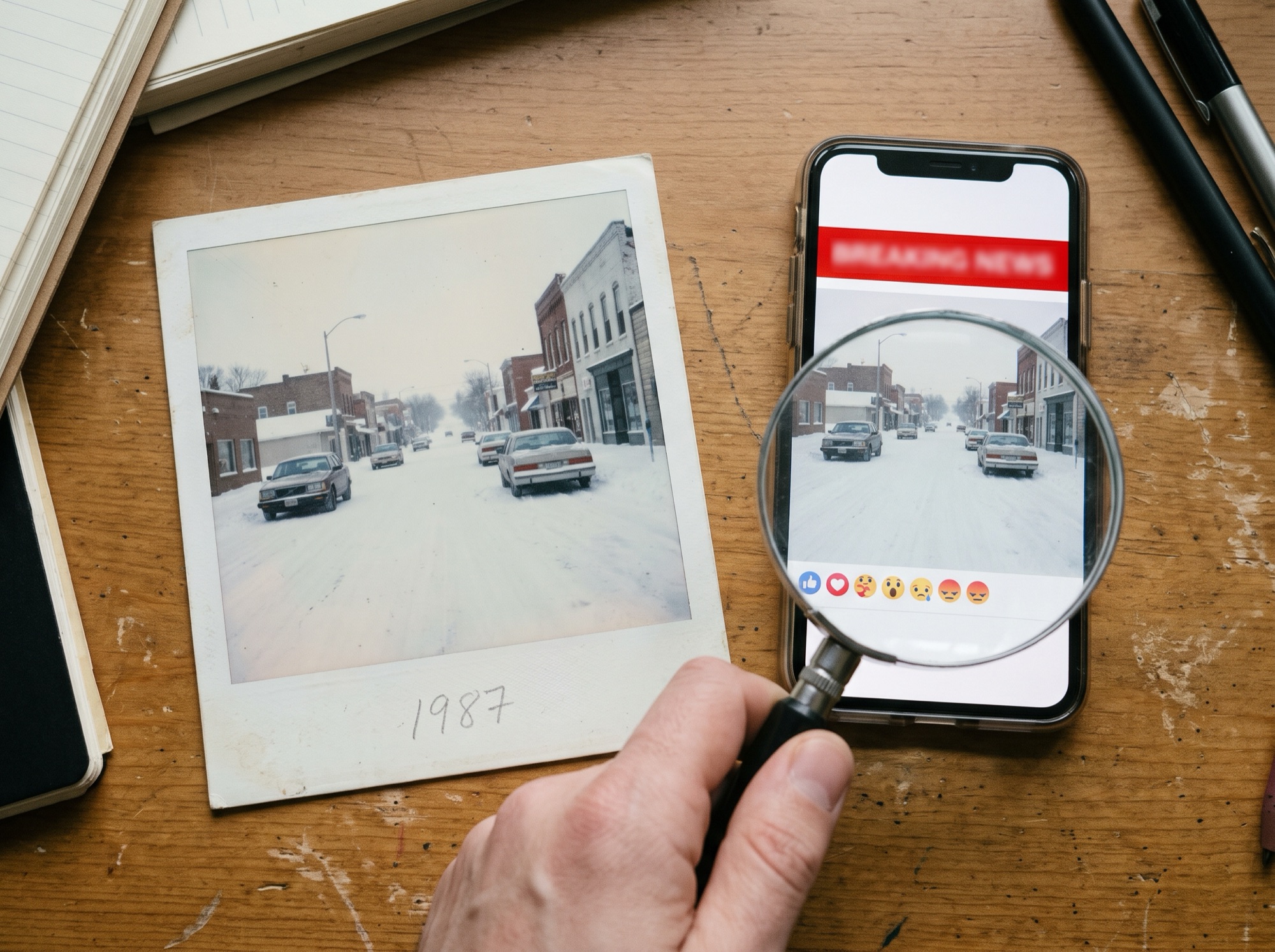
Old picture, new story

This photograph illustrates how real images are given new stories. On a desk lies an old print of a small-town street buried in snow, the year written by hand in its white border. Next to it, a phone shows the very same picture as a current post with a red alert bar and a long row of reactions. A magnifying glass hovers over the screen. The image refers to one of the most common forms of disinformation: not fabricated pictures, but authentic ones taken out of their time and place and attached to a new event, a new location or a new claim. Because the photograph is real, it passes the first test of credibility. For Challenge A7, the image shows that verifying an image means verifying its context: when and where was it first published, and by whom? A reverse image search often answers that question in less time than it takes to share the post.

.. continue >>
Source: Image generated using generative AI for the BRIDGE project.