The project Bridge is co-funded by the European Union. Views and opinions expressed are however those of the author(s) only and do not necessarily reflect those of the European Union or the Servicio Espanol para la Internacionalizacion de la Educacion (SEPIE). Neither the European Union nor the National Agency SEPIE can be held responsible for them. -- Number: 2025-1-ES01-KA220-HED-000359236 --

A museum. Seven Challenges. Four spaces to learn and transform

Documentary Photography

This is a collection of photographs or images related to the selected social challenge. Each image is accompanied by a brief description or narrative explaining its meaning and connection with the challenge.

A.1. Structural and intersectional inequalities that shape inclusion and social cohesion   Show all

The images selected for Social Challenge 1 aim to depict situations related to the structural and intersectional inequalities that shape social inclusion and cohesion. Their purpose is to help identify and understand some of the ways in which these inequalities can manifest themselves in everyday… Read more >>

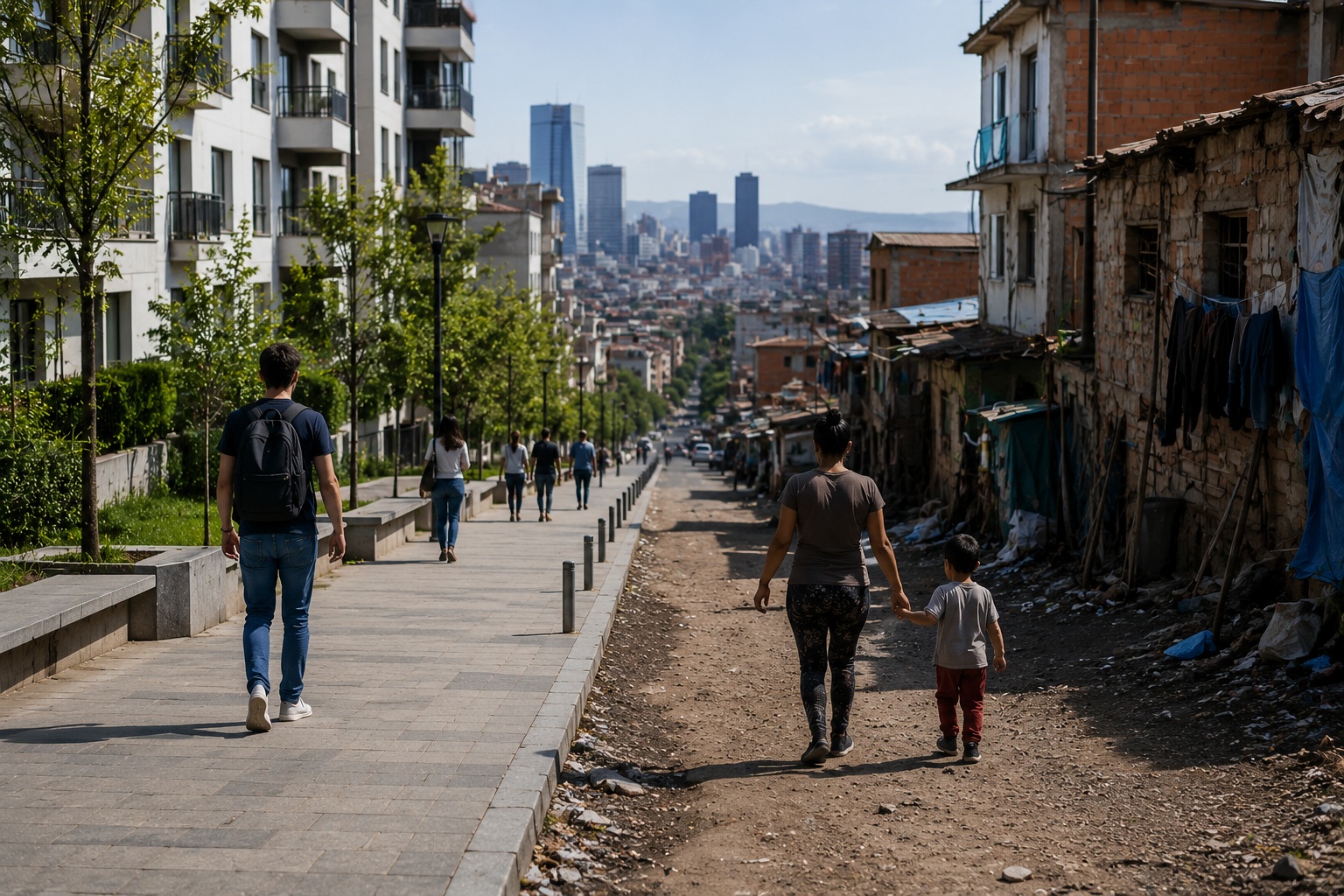
Same city, different starting points

This photograph illustrates how structural inequalities can manifest themselves within the same urban environment. Spatial proximity contrasts with differences in the quality of housing, infrastructure, public space and access to services, facilities and opportunities. People move through the same city, but they do so from different social and economic circumstances that may influence their opportunities, well-being and access to rights and services. The image invites us to move beyond individualistic interpretations of inequality and to recognise the role of structural factors such as socio-economic status, geographical location and the unequal distribution of resources. These conditions do not automatically determine individual trajectories, but they can expand or limit real possibilities for choice and participation. For Challenge A1, the image serves to introduce a central idea: sharing the same society does not mean starting from the same conditions or having the same opportunities.

.. continue >>
Source: Image generated using generative AI for the BRIDGE project.
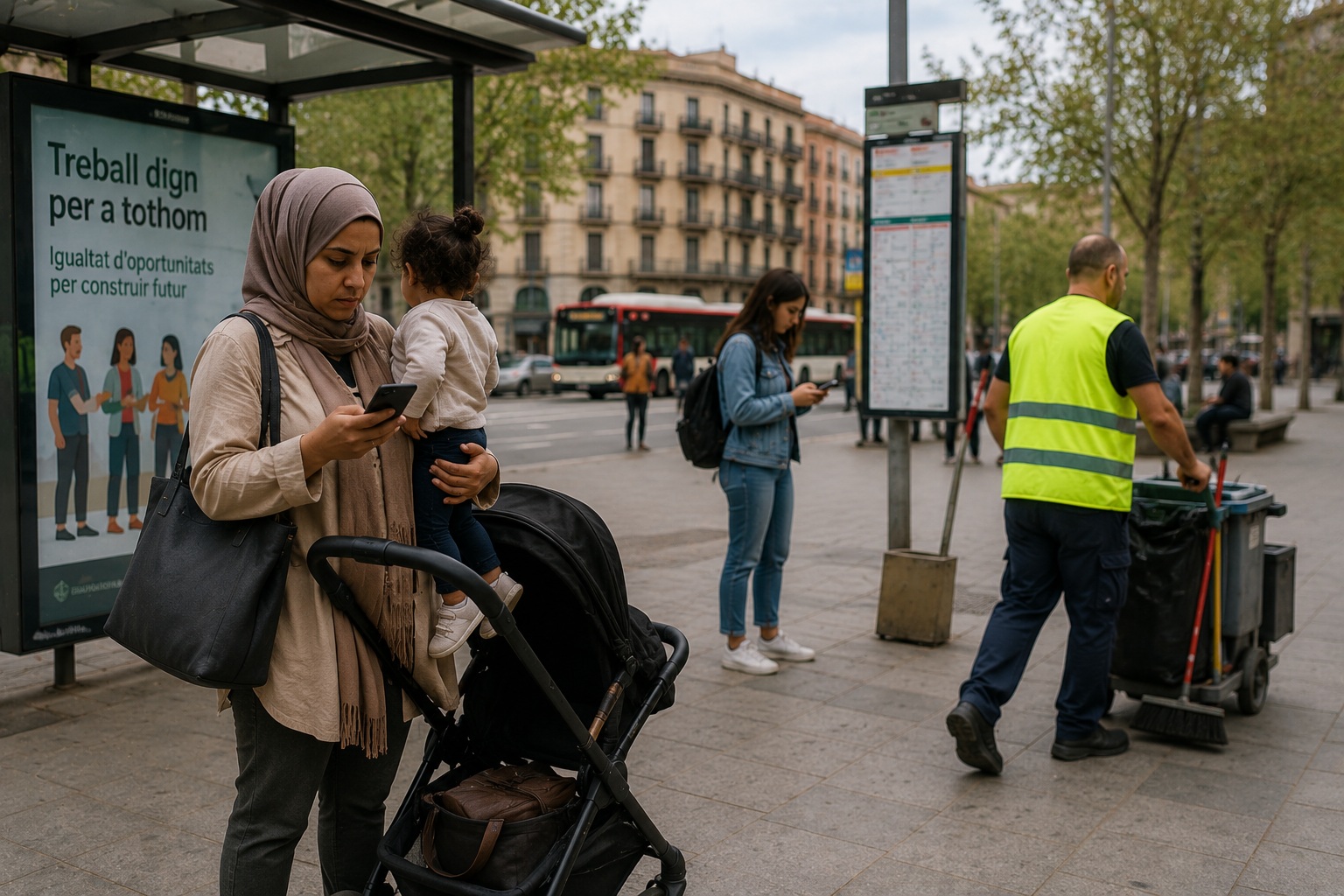
When inequalities intersect

This photograph illustrates how different factors of inequality can operate simultaneously in everyday life. The scene shows a woman with caregiving responsibilities in a socially diverse setting, shared by people in different employment, family and social situations. The image alone does not reveal each person’s background, origin or specific circumstances; precisely for this reason, it also invites us to distinguish between what we observe and the categories or assumptions we project onto those depicted. Gender, origin, socio-economic status, caregiving responsibilities, working conditions and access to resources and services can interact, creating different opportunities and challenges. The image encourages us to avoid explanations based on a single factor and to understand inequality from an intersectional perspective. For Challenge A1, the image helps to illustrate a central idea: inequalities do not operate in isolation, but intersect and can produce different experiences and effects depending on each person’s position and circumstances.

.. continue >>
Source: Image generated using generative AI for the BRIDGE project.
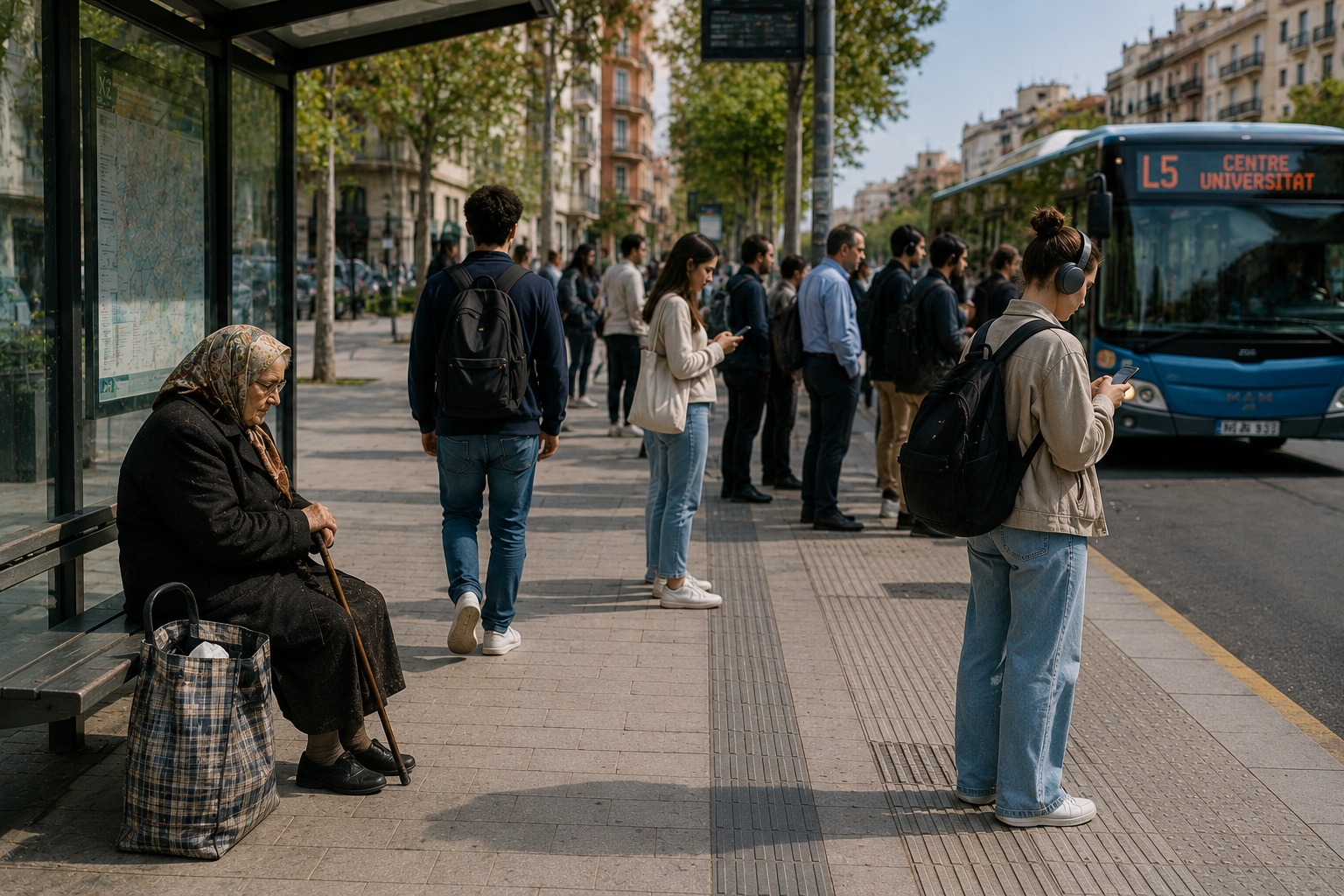
Same transport, different possibilities for access

This photograph illustrates how a public service that appears to be available to everyone can offer very different actual possibilities for access and use. At the same transport stop, people of different ages, social backgrounds, digital skills and mobility needs come together. Whilst some can easily look up information, plan their journeys and manage independently, others may encounter barriers related to age, language, accessibility, technological proficiency or their socio-economic circumstances. These barriers can be exacerbated when various factors interact; for example, when a language barrier is combined with information available exclusively in digital form, or when a mobility limitation coincides with an environment that is not very accessible. The image illustrates that the existence of a shared resource does not in itself guarantee equal opportunities. For Challenge A1, the image shows how structural inequalities also arise when services designed in an apparently neutral way fail to take into account the diversity of circumstances, abilities and resources of the people who are expected to use them.

.. continue >>
Source: Image generated using generative AI for the BRIDGE project.
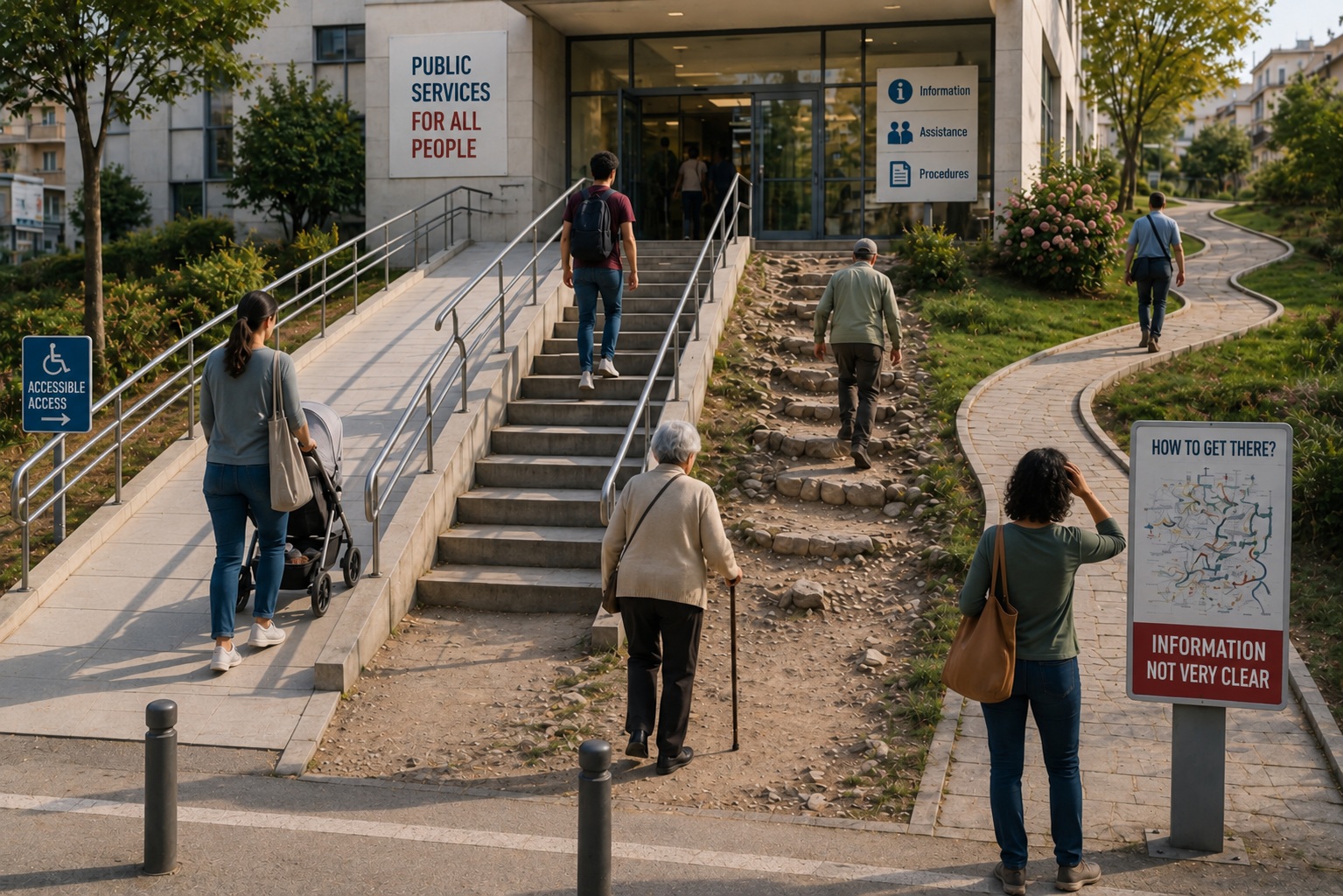
The same door, different obstacles

This photograph illustrates how formal access to the same service does not guarantee that everyone can use it on an equal footing. Although the destination is the same, the routes to reach it present varying levels of difficulty and demonstrate how age, mobility, care responsibilities, the accessibility of information or other circumstances can interact with the characteristics of the environment. Inequality thus arises from the relationship between people’s circumstances and an environment that can either facilitate or hinder their participation. The image thus shifts the focus from individual capabilities to the social, physical and organisational barriers that determine access to resources and opportunities. For Challenge A1, the image helps to illustrate a central idea of Challenge 1: equity does not consist of offering everyone exactly the same path, but rather of identifying and transforming the barriers that create unequal conditions of access and participation.

.. continue >>
Source: Image generated using generative AI for the BRIDGE project.
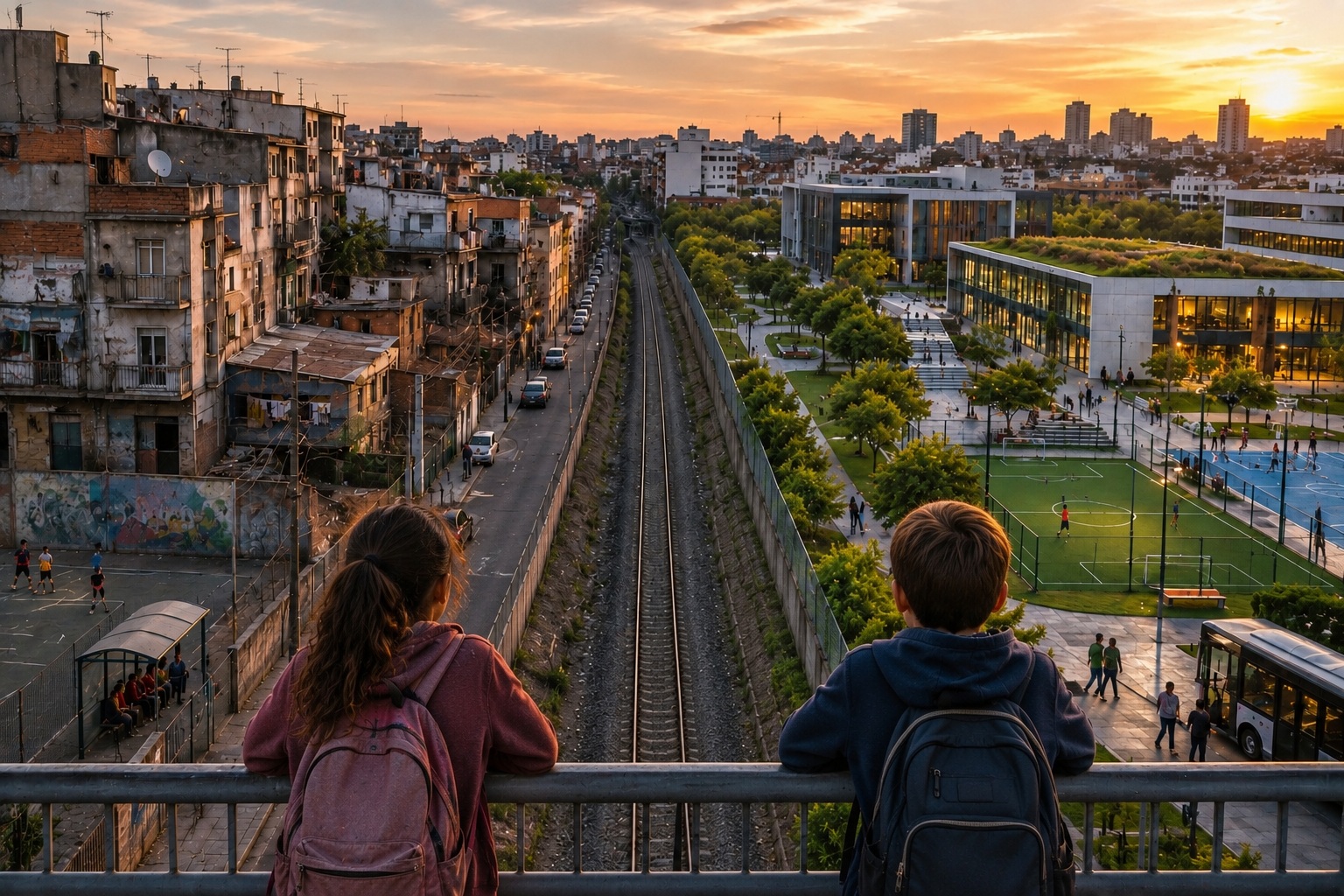
Growing up with different opportunities

This photograph illustrates how inequalities can begin to shape life trajectories from childhood and youth. A girl and a boy look out over the same city, where resources and opportunities are unevenly distributed. The environment in which children grow up can facilitate or limit access to educational, cultural, sporting, technological and participatory spaces, creating different starting conditions even before individual choices come into play. The presence of a girl and a boy also introduces a gender perspective, allowing us to explore how gender can interact with socioeconomic and territorial conditions, generating different experiences and opportunities. The physical separation between the two areas symbolises social and territorial barriers that can reproduce and accumulate inequalities over time. These starting conditions influence the opportunities available, but should not be understood as inevitable destinies: public policies, educational and community support, and the transformation of environments can help reduce them. For Challenge A1, the image helps to understand that opportunities during childhood and youth are shaped by the interaction of structural factors—including territory, socioeconomic status and gender—and that these conditions can influence subsequent educational, social and life trajectories.

.. continue >>
Source: Image generated using generative AI for the BRIDGE project.
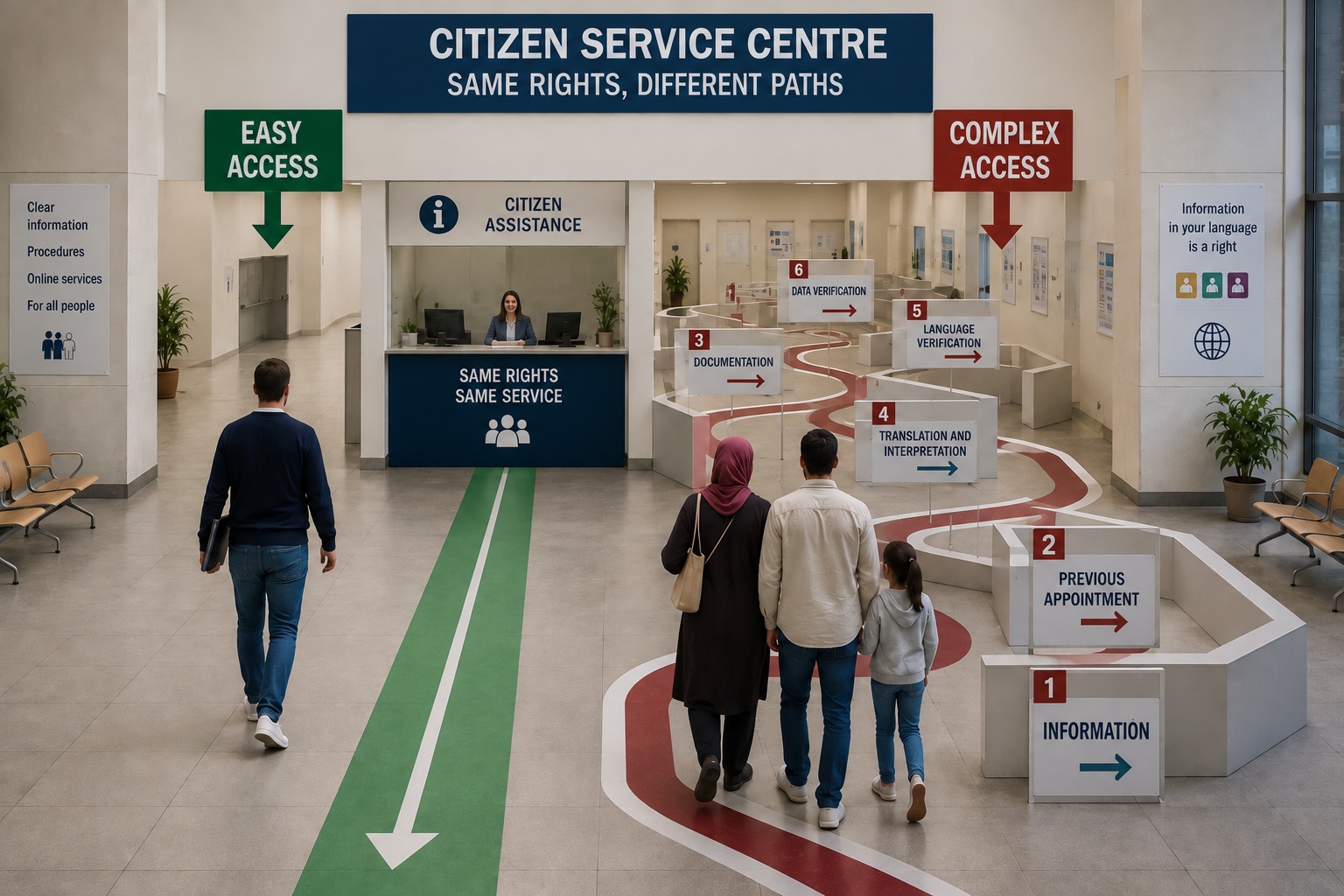
The same service, different barriers

This photograph illustrates how the same public service can be more accessible to some people than to others. Whilst some find the process straightforward and easy to follow, others face more complex procedures relating to documentation, administrative status, language, interpreting information or understanding the system. These difficulties do not depend solely on personal circumstances, but also on how procedures are designed, what knowledge is assumed, which languages are used and what support is offered. The image highlights the administrative, linguistic and institutional barriers that can particularly affect migrants, whilst avoiding attributing inequality to their individual characteristics. For Challenge A1, the image helps us understand that access to services and resources can be constrained by structures and procedures that create unequal pathways when they fail to take into account the diversity of people’s circumstances or guarantee effective conditions for accessing rights.

.. continue >>
Source: Image generated using generative AI for the BRIDGE project.
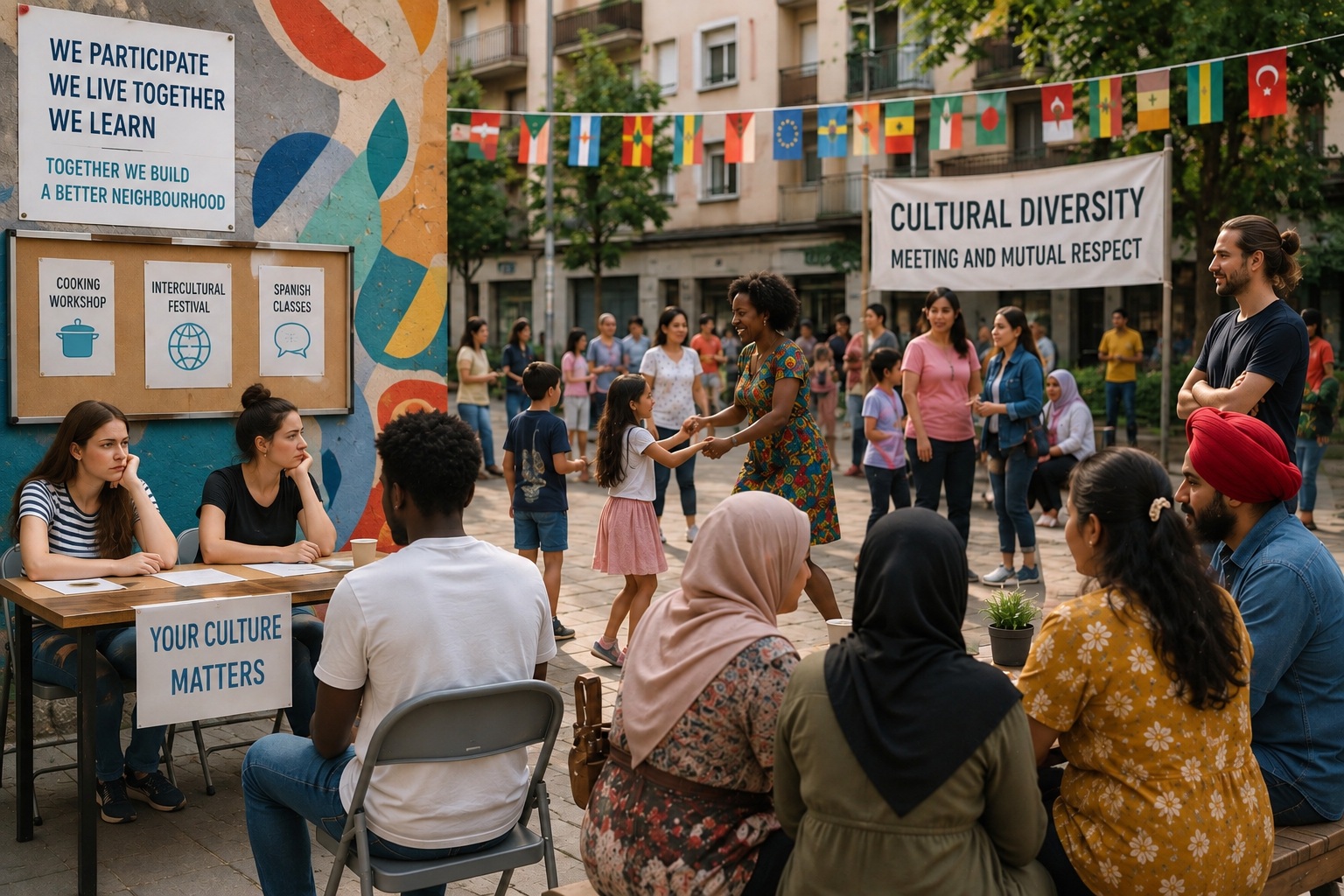
Living together does not always mean participating

This photograph depicts the cultural diversity present in many everyday spaces within European societies and highlights the difference between sharing the same space and participating in it on an equal footing. People from different cultural backgrounds come together for a community activity, but their presence does not necessarily mean that they all have the same opportunities to express themselves, be heard, take part in decision-making or have their experiences and cultural references recognised. Opportunities for participation may be influenced by power relations and by factors such as language, background, socio-economic status, social recognition or familiarity with decision-making spaces and mechanisms. The image encourages us to move beyond a view of diversity based solely on coexistence or the celebration of differences. For Challenge A1, the image helps us understand that the presence of diversity does not in itself guarantee equal participation, and that inclusion requires identifying and reducing the inequalities that determine who can speak out, be recognised and influence community life.

.. continue >>
Source: Image generated using generative AI for the BRIDGE project.
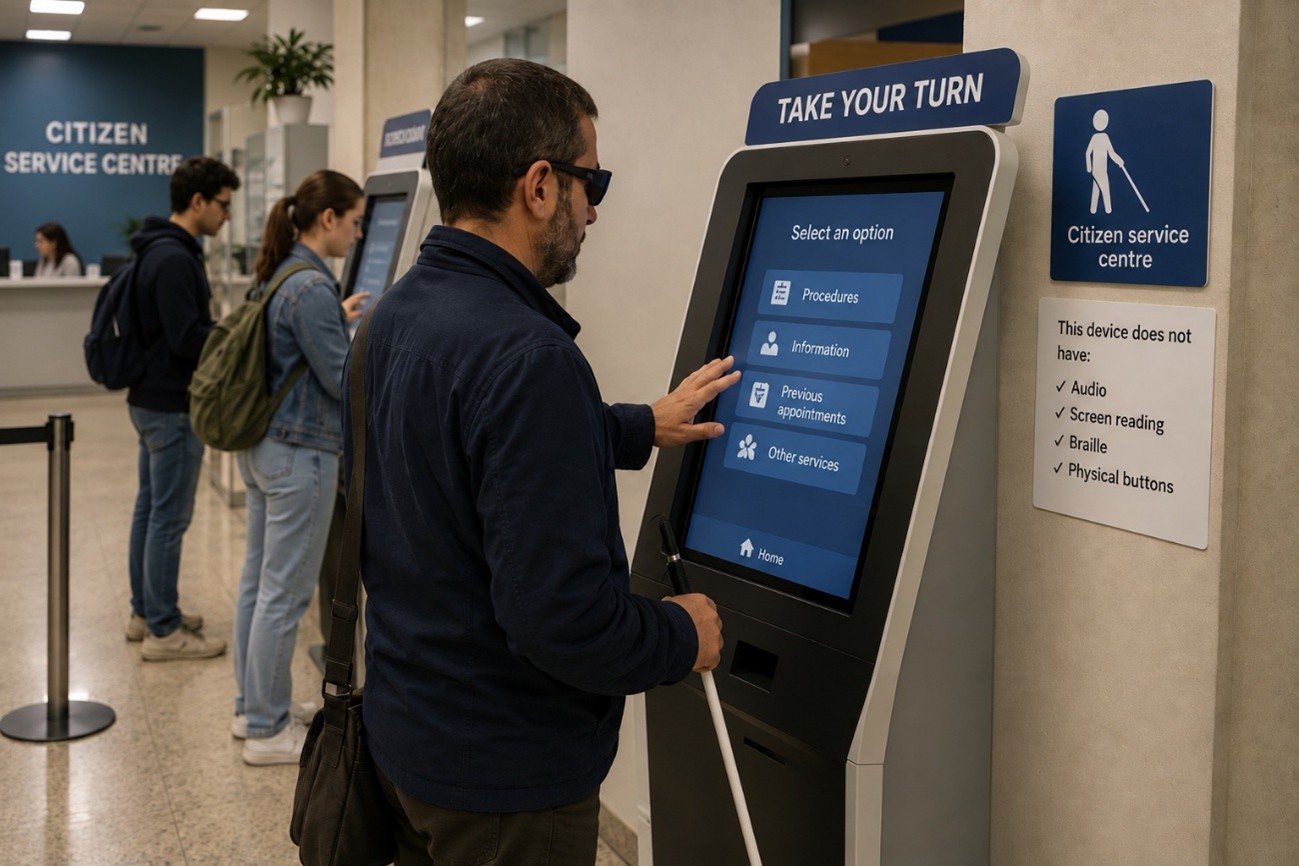
When design becomes a barrier

This photograph illustrates how certain environments, technologies and services can create inequality when designed without taking into account the diversity of the people who are meant to use them. A person with a visual impairment is faced with a service system based exclusively on a tactile and visual interface, whilst other people are able to use it independently. The difficulty does not stem from the person, but from the lack of accessible alternatives that would allow them to interact with the service on an equal footing. The image thus invites us to understand disability through the relationship between individual characteristics and environmental barriers. This perspective shifts the question from ‘what difficulty does the person have?’ to ‘what characteristics of the environment cause or exacerbate exclusion?’. For Challenge A1, the image demonstrates that equal access requires incorporating accessibility by design and removing the physical, technological, communicative and institutional barriers that may limit the autonomy, participation and exercise of rights of people with disabilities, whilst also recognising that these barriers may interact with other factors contributing to inequality.

.. continue >>
Source: Image generated using generative AI for the BRIDGE project.
When caregiving limits opportunities

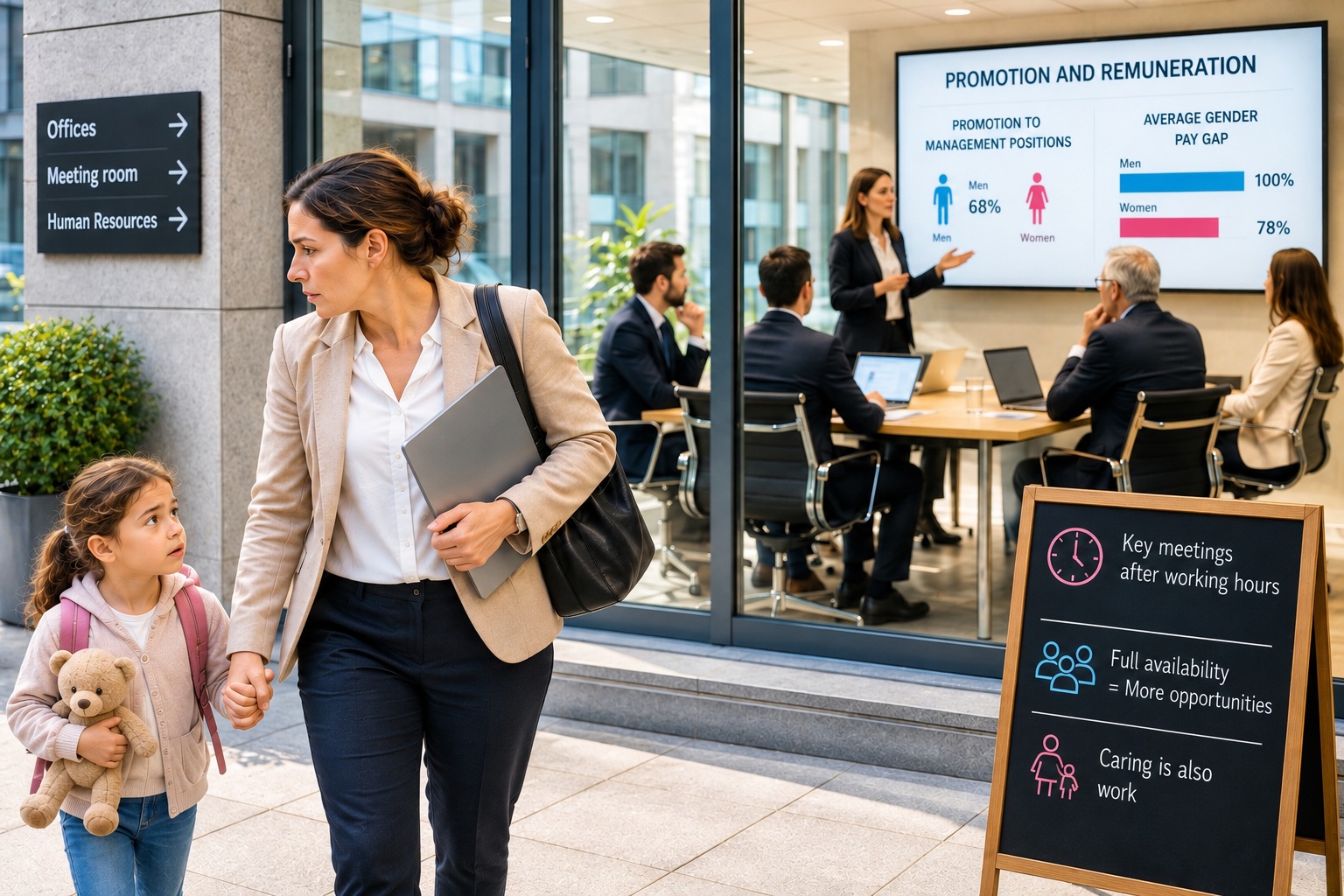
This photograph illustrates how the unequal distribution of care responsibilities can influence the career paths of women and men. Whilst a female employee leaves the workplace to attend to family responsibilities, a meeting relevant to her career progression continues outside normal working hours. The scene is not intended to attribute care exclusively to women, but rather to show how its unequal social distribution continues to affect them disproportionately and can interact with other factors such as social class, employment status or the availability of support networks and services. The scene illustrates how certain models of work organisation, based on availability and extended working hours, can create unequal opportunities for participation, recognition and promotion. These differences, which accumulate over the course of working lives, can also contribute to the gender pay gap. For Challenge A1, the image helps us understand that gender inequalities in employment are not solely the result of individual decisions, but are linked to the social organisation of care and to workplace structures that can turn these differences into barriers to promotion, career development and equal pay. Addressing them therefore requires shared responsibility, work-life balance policies and organisational changes, rather than individual solutions alone.

.. continue >>
Source: Image generated using generative AI for the BRIDGE project.
Different forms of support, shared opportunities

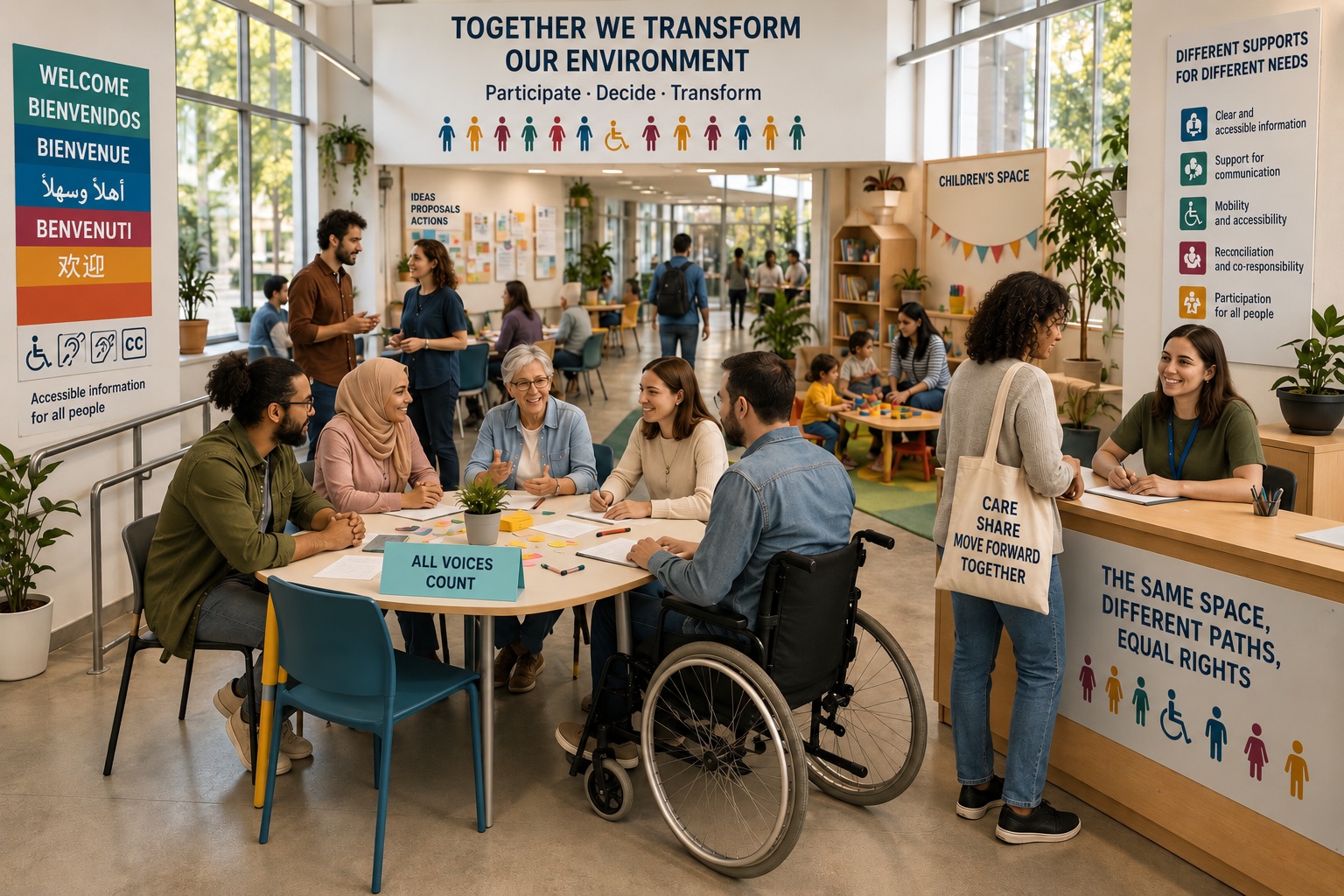
This photograph depicts equity as a means of transforming environments so that people in different circumstances and with different needs can participate on an equal footing. Within the same community space, accessibility measures, communication support, linguistic diversity, work-life balance facilities and different forms of participation coexist, integrated as a standard part of its operation. Diversity is not merely depicted; rather, the conditions of the environment have been designed to foster effective and shared participation. Support measures are not presented as exceptional concessions aimed at specific individuals, but as conditions of accessibility, recognition and justice that broaden the scope for participation across the whole community. For Challenge A1, the image concludes Challenge 1 by showing that promoting equity does not mean offering exactly the same thing to everyone, but rather recognising different needs, removing barriers and providing the necessary support to expand opportunities for participation, autonomy and inclusion, and to transform the structures that produce inequality.

.. continue >>
Source: Image generated using generative AI for the BRIDGE project.