The project Bridge is co-funded by the European Union. Views and opinions expressed are however those of the author(s) only and do not necessarily reflect those of the European Union or the Servicio Espanol para la Internacionalizacion de la Educacion (SEPIE). Neither the European Union nor the National Agency SEPIE can be held responsible for them. -- Number: 2025-1-ES01-KA220-HED-000359236 --

LEVEL 1. Analysis of ED/GCE Practices: Key Dimensions

BRIDGE Main Challenge: A.6. Deficits in democratic participation, representation and inclusive governance


What problem does it address?

The educational tool developed within the "Escolas Transformadoras" project directly addresses Social Challenge A6 (Education, Literacy, and Citizenship Skills) by tackling the crisis of traditional, reproductive educational models. These models often fail to prepare students for global complexities, resulting in a "deficit of agency" and a lack of critical engagement with reality.

What does it propose?

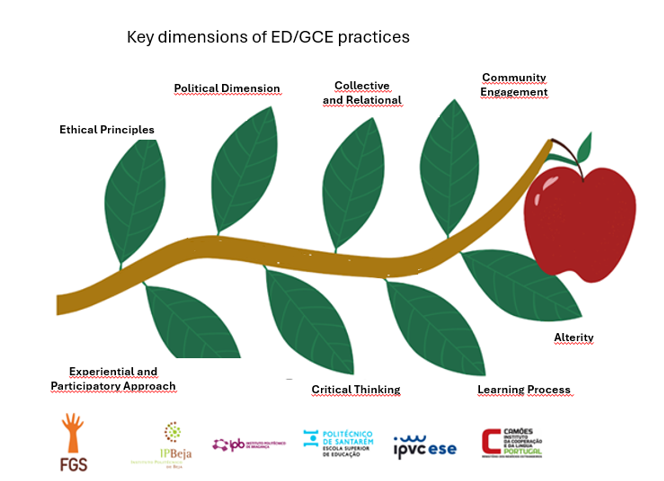
The tool uses the "Learning Tree" metaphor to evaluate educational practices through eight interfaces, including Critical Thinking, Ethical and Political Dimensions. It addresses structural inequalities by questioning the root causes of global imbalances, such as unsustainable economic models and power asymmetries, while fostering "Alterity" to challenge homogenization and social exclusion.

Why is it an inspiring practice?
  • - Addresses Critical Educational Gaps: It directly tackles traditional, reproductive educational models by combating the "deficit of agency" and lack of critical engagement among students.
  • - Fosters Deep Critical Reflection: Rather than offering rigid rules, it uses provocative questions that drive educators and management bodies through an "Action-Reflection-Action" cycle for continuous self-assessment and strategy planning.
  • - Focuses on the structural causes and root causes of inequalities: It moves beyond "palliative" measures by actively challenging power asymmetries, systemic inequalities, and unsustainable economic models.
  • - Promotes collaboration amongst various stakeholders: it breaks down institutional barriers by involving teachers, students and community representatives in the development of a collective, shared vision.
  • - Promotes Long-Term Sustainability: It focuses on embedding Global Citizenship Education into institutional policies, curricula, and organizational culture rather than relying on one-off initiatives.
  • - High Replicability and Accessibility: The tool is freely available online, adaptable to both formal and non-formal educational settings, and serves as a structured guide for planning, evaluating, and replicating transformative practices across different contexts.
Resources you'll find
  • The main feature presented is the tool for planning and evaluating ED/GCE activities. This tool is useful for planning and evaluating formal, informal or non-formal education activities in terms of how they align with the (theoretical and methodological) principles of Education for Development/Global Citizenship Education.
Featured results
1
Tool to support the planning and evaluation of educational activities within the field of Education for Development and Global Citizenship.
2
Reports on the systematisation of learning resulting from the implementation of the projects.
4
Collaborative articles on education for Development and Global Citizenship.
What can visitors learn?
- How to embed Education for Development and Global Citizenship Education (ED/GCE) into curricula, teaching practices, and non-formal educational settings.
- To analyze educational practices across eight key dimensions: Ethical Principles, Political Dimension, Collective and Relational, Community Engagement, Experiential and Participatory Approach, Critical Thinking, Learning Process, and Alterity.
- How to move beyond superficial actions to question root causes of global imbalances, power asymmetries, and social exclusion, while fostering recognition and respect for multiple identities (alterity).
- How to encourage active student participation, agency, and democratic engagement in learning processes and societal issues.
- How to foster dialogue, inter-institutional collaboration, and shared governance among teachers, students, higher education institutions, and community organizations.

LEVEL 2. EXPLORE BEST PRACTICE

Introduction

The practice addresses traditional educational models that fail to prepare students for global complexities, creating a deficit of agency and a lack of critical engagement. It tackles minimal student involvement in higher education decision-making regarding their learning and social justice issues like inequality, equity, inclusion, and the environment. Additionally, it targets the difficulties lecturers face in integrating ED/GCE into their teaching.

  • Coordinating organisation: Fundação Gonçalo da Silveira
  • Participating countries: Portugal (PT)
  • Duration: September 2018 - September 2026
  • BRIDGE Main Challenge: A.6. Deficits in democratic participation, representation and inclusive governance
Sustainable Development Goals (SDGs)
  • SDG 4: Quality Education
  • SDG 16: Peace, Justice and Strong Institutions
  • SDG 17: Partnerships for the Goals
Secondary Challenges
  • A.1. Structural and intersectional inequalities that shape inclusion and social cohesion

The Challenge

What social issue does it address?

This practice addresses the minimal involvement of higher education students in decision-making processes regarding their learning and key social justice issues. It targets traditional, reproductive educational models that fail to tackle global complexities, resulting in a deficit of student agency. It also responds to the challenges educators face in embedding democratic and citizenship skills into teaching.

Why is it important?

This good practice empowers and challenges educators to transform traditional teaching into a driving force for social change. By promoting, within the educational community the development of critical thinking, autonomy and the democratic values needed to combat inequalities and foster social justice and the building of fairer societies.

How does it contribute to the BRIDGE Challenge?

This good practice is in line with the principles of the BRIDGE Project in addressing Social Challenge A6, specifically by promoting democratic participation and student autonomy. It provides educators with a structured tool for integrating global citizenship, social justice and critical reflection into educational practices.

How does it work?

The tool provides a set of questions designed to encourage reflection on eight key dimensions of Education for Development. These questions assist in the planning, monitoring, and evaluation of educational practices, aiming to harness their potential for social transformation. It operates through an action-reflection-action cycle to transform traditional teaching.

What might inspire you?
Ideas for adaptation
  1. Promotes self-reflection on teaching by guiding educators to evaluate eight key learning dimensions.
  2. Offers structured questions to build participatory classes.
  3. Fosters critical thinking in students through encouraging questioning of global and social inequalit
  4. Prepares students for active civic engagement and governance.
  5. Drives transformative pedagogy through continuous reflection that generates social change
Resources created

Key Dimensions

Digital publication

The primary resource is the "Key Dimensions of ED/GCE" self-reflection tool, developed within the Transformative Schools project under the leadership of Fundação Gonçalo da Silveira. Grounded in the "Learning Tree" conceptual framework, the tool structures critical evaluation across eight core dimensions: Ethical, Political, Collective, Community, Experiential, Critical Thinking, Learning Process, and Alterity. Designed as an open-access resource, it provides educators and higher education institutions with a set of guiding questions to plan, monitor, and evaluate educational practices. The tool equips educators to embed democratic citizenship, social justice, and transformational methodologies into teaching.

Teaching staff, Students, Researchers

https://drive.google.com/file/d/1715NHg5LvH3pvUPRJQTF1QS25YEd2Vit/view